

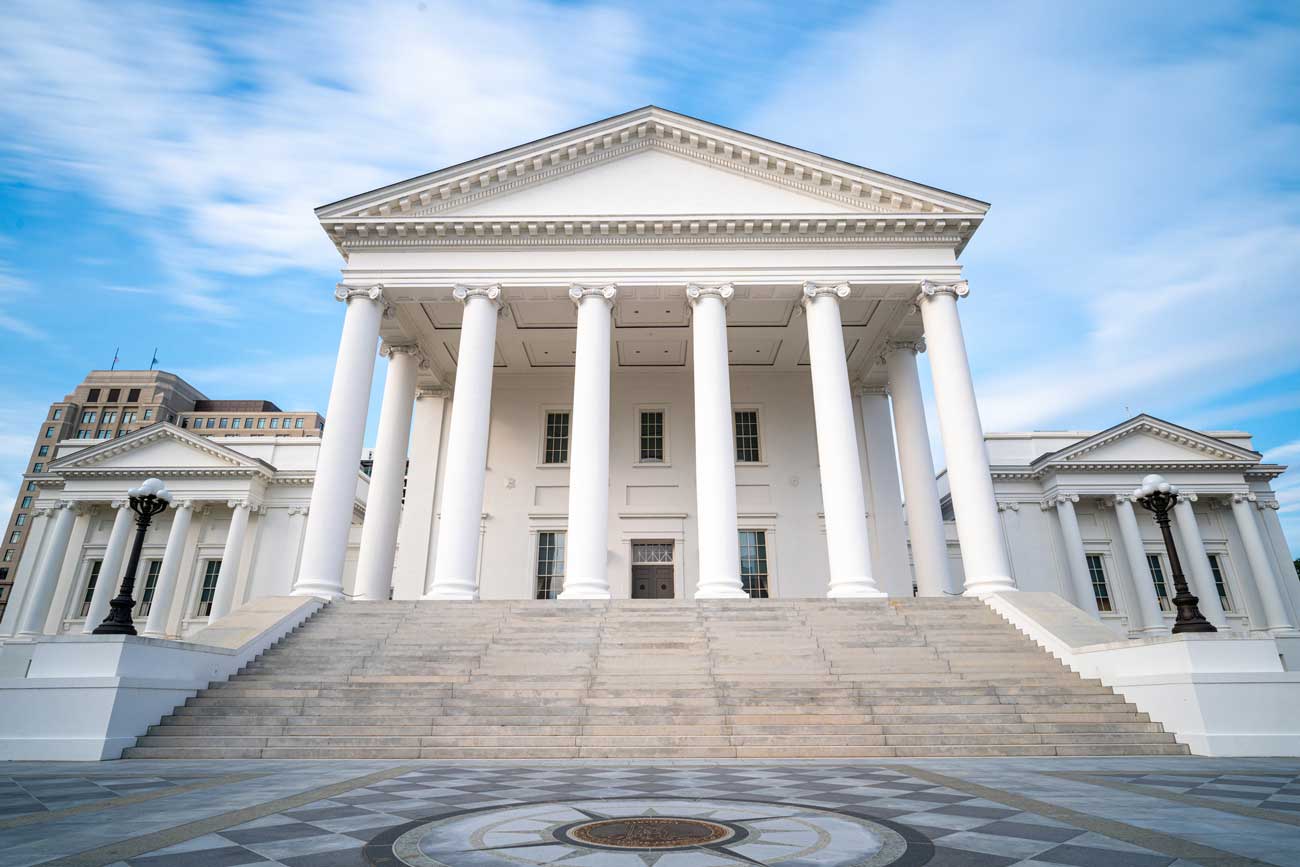
The Virginia General Assembly has passed House Bill 711, a measure that would reshape how localities regulate certain solar projects. As of March 16th, 2026, it sits on the desk of Governor Spanberger, who has until April 13th to sign it into law.
If signed by the Governor, the bill would limit local governments’ ability to use outright prohibitions or highly variable local restrictions to block qualifying projects whose approval applications were filed on or after July 1, 2026, while preserving local review through a more defined statutory framework. In place of broad local discretion, the bill sets out detailed statewide standards addressing many of the issues that have driven local opposition to solar development, including setbacks, screening, visual impacts, stormwater, revegetation, decommissioning, and related site-management requirements.
The purpose of the bill is to make the solar siting process in Virginia more predictable. It does not remove localities from the process. Nor does it require approval of every project. But it would require local review to operate within a clearer set of rules, rather than through a patchwork of local standards that can differ significantly from one jurisdiction to another.
What the Bill Covers
The bill’s structured review framework applies specifically to “solar photovoltaic projects,” defined as ground-mounted solar facilities of one megawatt or more that are designed to serve, or do serve, the electricity or thermal needs of property other than the property where the facility is located. Essentially, the legislation is aimed at larger, off-site-serving projects, not smaller on-site generation serving the host property itself.
For those covered projects, unless otherwise permitted by right, localities must use a special-exception or siting-agreement process and include reasonable regulations in their zoning ordinances that are consistent with the statute. The legislation also revises related provisions governing solar facilities on residential, agricultural, commercial, industrial, institutional, and mixed-use property, clarifying in several places when certain smaller or on-site-serving facilities are permitted subject to ordinary zoning requirements and when a project instead falls within the more structured local review process established by the bill.
The bill also addresses energy storage projects separately. Unlike the solar framework, which requires localities to use a special-exception or siting-agreement process for covered solar photovoltaic projects unless otherwise permitted by right, the energy-storage provision is more permissive. It provides that a locality may grant a special exception for an energy storage project and include reasonable regulations in its zoning ordinance.
The main objective is straightforward: to facilitate solar development while addressing the concerns that local governments and nearby landowners most often raise. The bill reflects a policy judgment that local review should continue, but that it should be guided by statewide parameters rather than open-ended local barriers.
Key Standards the Bill Would Put in Place
One of the bill’s most important features is its use of specific siting criteria rather than broad generalities.
Setbacks. The bill provides numerical ranges for setbacks from occupied community buildings and dwellings on nonparticipating properties, roads, wetlands, streams, Chesapeake Bay Preservation Areas, and shared property lines with nonparticipating properties. Localities may choose figures within those ranges, but the ranges themselves would be established by statute. The bill also allows nonparticipating property owners to waive setbacks by written agreement and clarifies that setbacks are not required for internal boundaries between adjacent participating parcels.
Because setbacks have been a particularly limiting issue in Virginia, due to several onerous setback requirements that render many projects economically infeasible, that provision of the bill bears reproduction here. Again, the bill states the limits of how high required setbacks can be in local ordinances:
“Setback distances shall be measured from the nearest edge of the equipment as follows: (i) between 150 and 200 feet from the nearest point on the outer wall of existing occupied community buildings and dwellings on non-participating properties; (ii) between 50 and 100 feet from the outside edge of the roadbed of any road abutting the property; (iii) for projects not greater than 25 megawatts, 50 feet from the edge, and for projects greater than 25 megawatts, 100 feet from the edge, of tidal wetlands or nontidal wetlands, as defined in 9VAC25-830, or from the top of bank of perennial streams, as defined in § 62.1-44.122; (iv) for projects of any capacity within Chesapeake Bay Preservation Areas, between 100 and 125 feet from the edge of tidal wetlands, nontidal wetlands, or from the top of bank of perennial streams; and (v) between 50 and 75 feet measured from the nearest shared property line for nonparticipating properties.”
Screening and fencing. The bill allows vegetative visual screening, but with limits. Screening may not exceed three feet at planting, must fall within a specified width range, and must account for natural or manmade visual barriers already in place. Fencing must comply with applicable safety and building-code requirements.
Height and visual impacts. Solar panels generally may not exceed 25 feet above ground when fully tilted, unless additional height is needed for agrivoltaics. The bill also requires that visual impacts on public parks, scenic rivers, and byways, and on certain historic resources, be minimized, and it allows localities to request a viewshed analysis as part of the application process.
Environmental performance and site restoration. The bill incorporates a detailed set of site-management requirements. It requires compliance with DEQ stormwater rules, calls for minimizing new impervious surface, and includes provisions on soil handling, stabilization, revegetation, and permanent vegetative cover. It also encourages the use of native and naturalized plantings, prohibits invasive species, and, in many instances, calls for maintaining pollinator or meadow species throughout the project’s life.
Wildlife and operations. The bill directs facilities to allow for wildlife passage where needed by limiting fencing to areas reasonably close to arrays and interconnection equipment, to the extent practicable and consistent with safety and security. It also requires light-intensity dimming technology. In addition, the bill requires compliance with applicable state and federal labor and employment laws, including apprenticeship and labor standards tied to certain federal tax-credit bonuses under Sections 45Y and 48E of the Internal Revenue Code.
Local Review Would Remain, But Within Defined Limits
The bill does not require localities to approve every application. But it does constrain how localities may regulate covered solar projects. It also provides that any condition involving land dedication, cash payments, or public improvements must be reasonably related to the project’s impacts.
The bill also adds a transparency measure requiring localities to provide the State Corporation Commission (SCC) with records of special-exception decisions, including the reasons for adverse decisions and whether the project was found inconsistent with the locality’s comprehensive plan. The SCC, in turn, would be required to maintain a searchable public database of those decisions for at least five years.
If signed, the act would apply to covered ground-mounted solar facilities for which an application for local approval is filed on or after July 1, 2026. Applications received and accepted before that date would remain subject to the ordinances in place when the initial application was filed.
Siting Agreements. H711 makes it clear that Boards of Supervisors and City Councils can, by way of Siting Agreements, extend leniency to developers beyond that provided in the bill. This underscores what we already know, which is that siting agreements are powerful tools for developers and jurisdictions:
“Nothing in this section shall… prohibit the owner of a proposed solar photovoltaic project and a locality from entering into a siting agreement that provides less stringent restrictions than those specified under this subsection.”
Conclusion
From a practical perspective, H711 is about predictability. For developers, it could create a more consistent framework for local approvals across Virginia. For local governments, it preserves a meaningful role in the process, but within clearer boundaries. And for communities, it signals that future solar development may proceed under more explicit standards addressing many of the issues that have made siting disputes contentious.
This is not the outright “preemption” of local solar ordinances that many local leaders have feared since the passage of the Virginia Clean Economy Act. It is, however, a very significant incursion into local control. It is up to Governor Spanberger as to whether 2026 is the year such steps are taken.

Sorry, the comment form is closed at this time.